In today’s fast-evolving digital world, AI Overviews, Generative SERPs, and Search Generative Experience (SGE) are not just buzzwords—they’re redefining how people interact with search engines. These tools, introduced by Google, are shifting the goalposts for marketers, content creators, and SEO professionals alike. Now, questions are being raised that were once unthinkable: Is traditional SEO dead in the age of SGE?
SGE and SEO: A New Era of Search Is Here
SGE and SEO are no longer separate conversations. Instead, they are now deeply intertwined. The introduction of Google’s Search Generative Experience has marked a major transition from the classic list-based Search Engine Results Pages (SERPs) to AI-generated summaries that answer users’ questions instantly.
SGE uses generative AI to deliver results in the form of concise, conversational overviews. These AI Overviews often take center stage—pushed above organic links—leaving less room for traditional listings. As a result, businesses are witnessing significant drops in click-through rates.
SGE and SEO strategies must evolve together. Without understanding how to work alongside Google’s AI, websites risk being buried, unseen, and ultimately irrelevant.
SGE and SEO: What Exactly Are Generative SERPs?
SGE and SEO innovation begins with understanding how Generative SERPs function. These aren’t the blue-link pages of the past. Instead, users are greeted with AI-curated summaries, key points, and sometimes even product suggestions—all before they ever scroll to the first organic result.
SGE’s goal is speed and simplicity. The AI aims to satisfy search intent in a matter of seconds. And it does this by extracting information from various sources and presenting it in a summarized format that feels conversational, intuitive, and remarkably accurate.
For SEO professionals, this shift presents both a threat and an opportunity. The threat is obvious—fewer clicks. But the opportunity? To become the trusted voice the AI chooses to summarize.
10 Techniques to Optimize for SGE and Google’s AI-Driven SERPs
To stay relevant in the era of SGE and SEO, it’s time to shift your approach. The following 10 techniques will help position your content in alignment with Google’s generative model:
1. SGE and SEO Need Intent-Driven Content
SGE and SEO both depend on understanding user intent. What is the user really looking for? Go beyond keywords and focus on real human questions. Provide thoughtful, direct answers. Repeat: provide answers, not just information.
2. Structure Content for AI Consumption
Google’s AI loves clarity. Use H2 and H3 subheadings, bulleted lists (when truly helpful), and short paragraphs. Incorporate schema markup so that your content can be understood not only by humans but by machines.
3. Keep Language Simple and Readable
Write at a 6th to 8th-grade reading level. Avoid jargon unless your audience demands it. Use transition words like “however,” “for example,” and “in contrast” to guide both the reader and the AI through your ideas.
4. Cite Reputable Sources
Trust is everything. SGE sources information from reliable, up-to-date pages. Link to studies, publications, and expert commentary. This signals to Google’s AI that your content is rooted in authority.
5. Update Frequently and Keep It Fresh
SGE prioritizes recent content. Update old blog posts. Add new statistics. Refresh examples. Remove outdated references. A living website is more likely to be featured in dynamic AI Overviews.
6. Optimize for Long-Tail and Conversational Queries
People search differently when speaking. Optimize for voice-style questions like “What does SGE mean for SEO?” or “How do Google’s generative SERPs work?” These long-tail queries are golden in the age of AI search.
7. Incorporate Multimedia with Smart Alt-Text
AI doesn’t just read text. It also scans image descriptions. Add relevant visuals with descriptive alt-text containing keywords like “SGE and SEO” or “Generative SERPs explained.”
8. Use Internal Links for Context
AI systems value context. Link related blog posts, guides, or product pages within your content. This creates a web of knowledge that both readers and AI can navigate.
9. Publish Unique Insights and First-Party Data
Don’t regurgitate what everyone else is saying. Share your company’s data, test results, or survey findings. Unique content adds value and makes you stand out.
10. Talk Like a Human, Not a Robot
Even AI prefers human-sounding content. Use natural phrasing. Vary your sentence structure. Start with short sentences, then expand. Ask rhetorical questions. Invite curiosity.
SGE and SEO: How Click Behavior Is Rapidly Changing
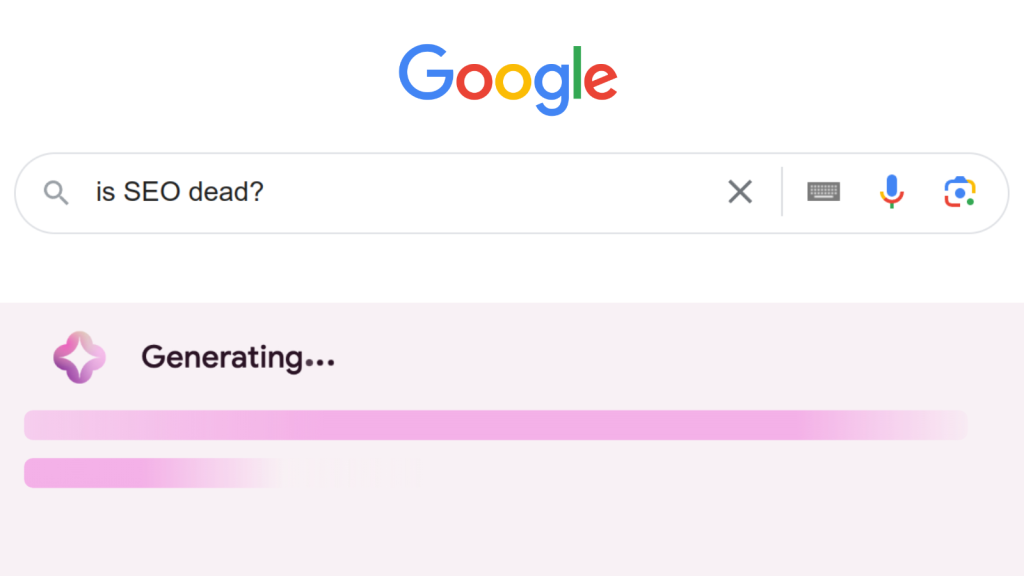
SGE and SEO are also altering how users behave on search engines. In the past, users scanned the top few links. Today, many never leave the SERP at all. This is known as the “zero-click” phenomenon—and it’s becoming the norm.
With AI Overviews answering queries directly, users are less inclined to click through. For businesses, this means traditional SEO KPIs are no longer reliable. Instead of chasing rankings alone, the new goal is visibility within the AI summary.
Still, this doesn’t mean all hope is lost. If your content is cited within an overview, brand awareness can grow even without a click. It’s a different game. But one that can still be won.
Is Traditional SEO Really Dead?
SGE and SEO may sound like rivals, but in reality, they are evolving together. Traditional SEO isn’t dead—it’s just being reborn.
Sure, the rules have changed. You can no longer rely solely on backlinks or keyword density. The focus now is on relevance, expertise, and clarity. Traditional SEO is not obsolete, but it must be upgraded to thrive in a generative search environment.
Here’s the truth: People still need great content. They still want to dig deeper. They still want stories, explanations, comparisons, and insight. SGE just changed how they find those things.
SGE and SEO: Future-Proofing Your Content Strategy
So, what’s the best move forward? First, accept that generative AI is here to stay. Second, build content that respects both human curiosity and machine logic.
- Create topic clusters around your core niche.
- Use your blog as a content hub that answers real questions.
- Maintain your site structure, speed, and mobile-friendliness.
- Most importantly, don’t chase the algorithm. Serve the user.
The brands that win in this new age are the ones that align their goals with the experience Google is trying to build.
Final Thoughts: SGE and SEO Can Coexist
SGE and SEO do not have to be enemies. They are different paths to the same goal: helping people find what they’re looking for.
While AI Overviews and Generative SERPs reduce clicks, they increase demand for meaningful, accurate, and helpful content. If you can become the site that AI trusts to summarize—if you can provide clarity in a world of noise—you’ll thrive.
So, is traditional SEO dead in the age of SGE? Not quite. But it’s no longer the same. It’s evolved. And now, it’s your turn.